Your vote. Your co-op.
As a member-owner of TPSS Co-op, your voice shapes the future of our co-op. Each year, members elect representatives to the Board to guide our direction, uphold our cooperative principles, and ensure TPSS continues to thrive as a community-owned grocery store.
About the Election
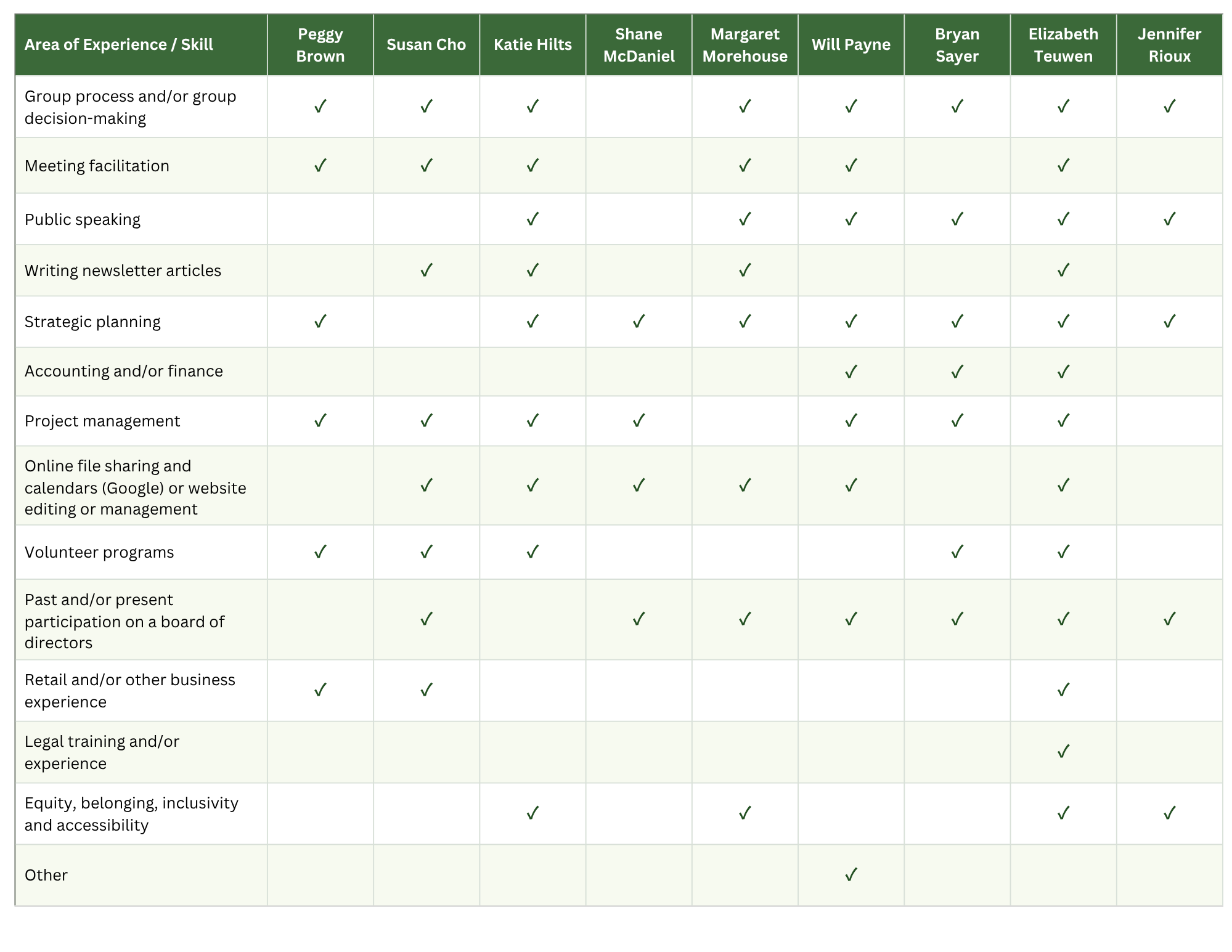
Nine candidates are running for six open seats on the TPSS Board of Representatives. Learn about each candidate and cast your vote to help shape the next chapter of our co-op!
For each eligible member vote, TPSS will donate $1 to Crossroads Community Food Network, a local organization that makes it easier for our low-income neighbors in the Takoma/Langley Crossroads to buy fresh, healthy food.
Voting is open from October 18 to November 15.

Meet your candidates
- Peggy Brown
- Susan Cho
- Katie Hilts
- Shane McDaniel
- Margaret Morehouse
- Will Payne
- Jennifer Rioux
- Bryan Sayer
- Elizabeth Teuwen
Peggy Brown: I worked as a health educator in hospitals and public health departments for over 30 years. I have been part of Coops my entire adult life-food, school, childcare-serving in various volunteer positions and ultimately benefiting greatly. I have also volunteered in food banks, food kitchens, and at community events. And, I even ran an independent coffee shop at one point in my life.
Susan Cho: I served on the Board of Representatives of the illustrious TPSS Co-op for 7 years, from 2015 to 2022. During that time, I was also part of two other community-oriented endeavors: FullFillery, a zero waste shop in downtown TP, and Maitri House, an intentional community across the street from the Coop. I moved to New England for 4 years, during which time I was always part of a local food coop. I served on the board of directors for a regional community chorus, which I thoroughly enjoyed. I also became a member of a makerspace in New Hampshire, where I met people who generously shared their knowledge and materials. I moved back here in July. I’m back at Maitri now and am hoping to find or start a makerspace here.
Kate Hilts: I'm a very active member of my union, where I'm on the bargaining team and chair two committees, so I'm quite familiar with democratically-run organizations with a board governance structure, plus employed staff, and dues-paying members (and all the joy and mess therein!)
Shane McDaniel: I’ve lived in Takoma Park since August 2025 and became a Co-op member the same day I closed on my house. I chose to live in Takoma Park for its smaller community feeling and connection, and see the Co-op as a manifestation of that.
Previously I was on the HOA board for my townhouse community of 86 units for a few years, and have so far served for a year on the Bargaining Committee for the nascent Employee Union at my work. (I would step back from that role if elected to the Co-op board)
Margaret Morehouse: I have been a Coop Board Member since 2025. I have served on or supported various boards for both for profit and not-for profit organizations (Visiting Nurses, Group Health Cooperative of Puget Sound, Pacific Medical Center, Training Resources Group, Inc, International Livestock Research Center, Takoma Park Board of Elections). I currently volunteer at the Smithsonian Institution (National Museum of African Art), the League of Women Voters, and as an election judge for Montgomery County.
Will Payne: I am a newer Takoma Park resident (2025) with my wife and son.
- Worked in local government for over 10 years in management and budget, responsible for long-range financial planning, annual and multi-year operating and capital budgets, performance management, sustainability, procurement, and overall organizational strategy.
- Previously served on volunteer neighborhood association board (Crescent Heights Neighborhood Assn - St. Petersburg, FL) and professional associations committee (Florida City/County Management Association Professional Development Committee)
Jennifer Rioux: I have served on half a dozen boards in the past 20 years, primarily focused in the nutritional and health professions. My work includes food justice and health justice as well as relational and community-driven aspects of health. Most of the boards I have served on have been shepherding growth initiatives.
Bryan Sayer: In the 1980's I served on the Boards of several co-op organizations including housing, development, and grocery. I am currently retired and volunteer with Statistics Without Borders (SWB) and Humanitarian Open Street Map (HOTOSM). I also served as the chair of the Employee Owners Communication Committee (EOCC) at the ESOP where I worked in the late 2010's.
Elizabeth Teuwen: I am a former attorney and chef with a longstanding commitment to food access, community well-being, and cooperative principles. For the past five years, I have worked at the Montgomery County Food Council because I believe strongly in the importance of ensuring that everyone has access to healthy, affordable food. This experience has deepened my understanding of the challenges facing local food systems and the value of collaboration in addressing them.
For the past six years, I have also served as a TPSS Co-op board member. This role has allowed me to put my beliefs into action in my own neighborhood while gaining valuable experience in governance, community engagement, strategic decision-making, and supporting the success of a member-owned organization.
Peggy Brown: I'm very organized and able to set up systems when needed. I have managed departments and programs which included overseeing budgets. It is not a major skill of mine, but I'm not wary of doing it. My main skills are in communication, marketing and community outreach. These skills would hopefully be helpful as we move to acquire and run a second store.
Susan Cho: When I was on the Board before, I chaired the Policy Committee, so I have a good grasp of Policy Governance. I also served as Secretary for a year. I’m well versed in Google Drive, having kept documents and spreadsheets organized for Maitri House. I can navigate difficult conversations with skills I’ve learned at Maitri, where we practice mindful conflict resolution using facilitation. I was also part of the negotiating team for the Co-op during mediation with NDC about their proposed development of the Takoma Junction parking lot.
When I co-managed FullFillery, I took care of finding, ordering, and tracking inventory; maintaining vendor accounts; filing legal and financial papers; managing payroll; maintaining our website; and managing customer relations. For FullFillery and the Monadnock Chorus, I managed the Facebook page.
Kate Hilts: In my day job, I'm a digital communications professional with an organizing and mobilization background. I think my skills could be useful as the co-op's second location project enters its next stage-for example, -the discussion at the board meeting about making calls to member-investors reminded me of all the political phonebanking I've done on campaigns! My hard skills include social media management, online newsletter writing, digital fundraising, graphic design, mass SMS programs, and website management, among other things. Whether I like it or not, I'm also known as the "planner" in my friend groups, which involves organizing potlucks and sending out a lot of doodle polls to schedule the next book club.
Shane McDaniel: I’m a software engineer, and an important part of my work is to find the simplest and most efficient ways to address the problem at hand. Additionally, I’m very data driven so that outcomes are shaped by, and in service of, the real world and not other biases.
On my previous HOA board, we had a problem where the community paid for everyone’s water. When there was a leak, we had no way to know who to reach out to to address it. Working off of city architecture plans, I mapped 14 water meters to which of the 86 units they serve. I created a spreadsheet that we could copy and paste our water bills into, see which meters were experiencing historically unusual usage, and which units those were to contact.
Margaret Morehouse: Team building, meeting facilitation, policy development, strategic planning, training.
Will Payne: Served as Performance & Budget Director for a full-service City with over 1,000 employees, developing and managing $250M+ annual operating budget and $250M
- Helped achieve financial reserve targets while also investing in new service expansion and capital facility construction (new fire stations, mixed-use City Hall/commercial complex, and others).
- Master of Public Affairs from the University of Texas at Austin; formal professional development/training in Lean Six Sigma process improvement, meeting facilitation, organizational change management, and organizational performance & strategy.
- Experience on the municipal side with planning, zoning, community meetings, real estate acquisition, facility construction, and long-term financial planning for maintenance, operations, and service/facility expansion.
Jennifer Rioux: I bring leadership and relational skills. Infrastructure building and a focus on process outcomes. I'm an ideas and visioning person.
Bryan Sayer: I served as the treasurer of a housing co-operative development program and the treasurer of the student government assembly in graduate school. In addition, my undergraduate degree is in business.
Elizabeth Teuwen: As co-executive director of the Food Council, I lead a nonprofit organization and oversee all financial operations, including budget development, financial reporting, and resource allocation. Additionally, in my six-year tenure on the TPSS Co-op board I have gained deep familiarity with cooperative finance, governance structures, and the fiduciary duties required when serving member-owned organizations.
The Food Council is a convening organization, so much of my work involves bringing together people and organizations with different perspectives, priorities, and areas of expertise. I am skilled at facilitating discussions, building consensus, and making sure all voices in the room are heard. I also understand the complexity of our local food system and the important role TPSS Co-op plays within it.
Peggy Brown: I moved to TP in January 2024 and immediately started to volunteer, both to meet like-minded people but also to get to know the community. I'm now ready to become more deeply involved and the Board seemed a perfect way to do so. I'm a foodie, joined the Coop as soon as I moved and shop here regularly, so the Board would be the next step.
Susan Cho: The time that I served on the Board before was very meaningful to me. I was able to contribute a lot of time and energy to the work we did, and I think the board as a whole was able to guide the Coop wisely in some tricky situations. I’d love to offer my services again, this time as someone with a sense of the recent past, but also with an outside perspective, having been a member of two other food coops since then. With both of my two previous Board experiences, I’ve made good friends, which is of personal benefit to me!
Kate Hilts: I first moved to DC a week after graduating college, and feel very rooted in this community. The DMV has changed a lot since then, and in some ways times seem darker, but since becoming a co-op member last year I've been genuinely inspired by the hopeful community hub that it is. It's one thing to shop at a natural foods store and buy organic vegan food (which I do) but another to support an organization that is fighting dynamic pricing in Maryland, employing a unionized workforce, creating community, and proving that local, democratically-run institutions are viable and vital. It's exciting that the co-op isn't just maintaining this great work but expanding its footprint, and I would love to contribute to this next chapter.
Shane McDaniel: I believe community is built and sustained by being in service to each other and individually contributing. The Co-op serves a unique and vital service to the local community and I would like to be part of ensuring that it continues to be healthy and prosperous for us all.
After serving on a HOA board for 86 families and a Union bargaining committee I also see the Co-op Board as a next step in exercising and building on skills I’ve developed through those services.
Margaret Morehouse: I think the coop is pretty wonderful. I admire how it navigated Covid and the remodel--particularly in terms of meeting the needs of both members and shoppers, and staff. I want to support the coop to thrive well into the future and I think one way I can do that is through board service.
Will Payne: As a resident and neighbor of the Co-Op, I appreciate it for many practical reasons - the convenience of having a high-quality grocery store in the neighborhood, with great hours and helpful staff. More than just the practical reasons, I am even more invested in the fact that the Co-Op exists as a community anchor and institution in Takoma Park/Silver Spring, providing more than just the products on its shelves.
As the store looks to expand to a second location, I believe my skills and experience could be put to use to help support the Co-Op and help guide the expansion project to enable long-term sustainability and success of.
Jennifer Rioux: I am very community-minded and have been a member of the TK PK volunteer fire department. It is important for me to be embedded in my community and focus any volunteerism locally in a way that uplifts everyone equally.
Bryan Sayer: I think this is an exciting time for the co-op with the addition of the second store. My experience with co-op development should be a good addition to the board.
Elizabeth Teuwen: I am interested in serving a third term because I care deeply about the Co-op’s present role in the Takoma Park community and its future as the co-op grows. I began my board service during the height of the pandemic, when survival was the primary goal and connections with fellow member-owners took place almost exclusively over Zoom. Since then, I have seen the co-op emerge from survival mode, transform through the remodel project, and move toward the exciting possibility of opening a second store location. This experience has given me a deep appreciation for the co-op’s resilience, as well as a strong desire to help sustain its success. I am especially interested in supporting expansion in a way that preserves TPSS Co-op’s identity and values while bringing the benefits of cooperation to a new community. I look forward to engaging member-owners, listening to their perspectives, and helping ensure that the co-op’s initiatives reflect its mission and the principles of cooperation.
Peggy Brown: I like them all, but feel most strongly about the idea of everyone involved having the chance to participate, and the sharing that occurs when that happens. I truly believe we are here to help one another and the the cooperative way is essential in accomplishing this.
Susan Cho: Concerns for the Community: This is why TPSS is so dear to my heart. If it just provided healthy, organic, local goods, I would still shop here as much as possible. But I also deeply appreciate its focus on keeping the community alive and thriving. The cohesiveness of a community is of utmost importance, especially these days. I’m grateful to be part of a business that constantly reinvests in our community.
Kate Hilts: All seven of the cooperative principles resonate with me, but concern for community jumps out at me most today. I'm increasingly concerned not just about the structural threats to a healthy, peaceful, progressive society (fascism, climate change, etc.) but also the isolation so many Americans are experiencing in the "loneliness epidemic." A sense of alienation from one's community, one's neighbors, and the people on whom we rely daily (e.g. the people who grow and sell our food!) feels, to me, inextricably linked with our societal ills. Of course, the co-op creates community in obvious ways like the member picnic and the Friday outdoor lunches, but I really believe in the value of an institution that asks you for something besides money-membership, feedback, voting, engagement. That sense of community obligation and inter-connectedness is invaluable. A democratically-run food cooperative creates community where we need it most, and also, in a disconnected capitalist world, where some consumers expect it least.
Shane McDaniel: Democratic Member Control is important to me as it’s the manner in which we collectively come together, express our shared goals and achieve them. It ensures that there’s clear expectation for all in how decisions are made and how change can happen. Power structures too often distance decision makers from those impacted by their decision, and democratic member control helps ensure the Co-op’s power is retained by its members.
Margaret Morehouse: Its hard to pick a favorite because they reinforce one another. That said, I like the way that the principles of voluntary and open membership and democratic member control work together to differentiate the coop from other enterprises. And concern for the community is one of the things that first caught my attention about the coop and encouraged me to join.
Will Payne: My favorite Cooperative principle is Concern for the Community - knowing that the organization is invested in not just its own success, but that of the community, is deeply aligned with my own personal values. This guiding principle isn't just a principle on paper - it's backed by the power of member-ownership, democratic control and and operating model that is genuinely more community-focused than many other grocers and businesses.
Jennifer Rioux: My favorite co-op principle is concern for community because I believe in unity, democratic decision making, the relationship between small business and social support and care as the foundation of interaction.
My second favorite is: autonomy and independence because food sovereignty and community sovereignty are connected. Being empowered to care for ourselves and our families through health foods is an aspect of freedom.
Bryan Sayer: As defined by the International Cooperative Alliance (ICA) there are seven principles. My favorite is "Concern for Community". A co-op, particularly a grocery co-op exists in a specific community defined by partially by geography but primarily by the members, shoppers, and employees. All of these are stakeholders in the co-op who may have different
Elizabeth Teuwen: My favorite co-op principle is Concern for the Community. I value it because it transforms the Co-op from just a neighborhood grocery store into a local institution that strengthens and supports its shoppers, employees, producers, and Takoma Park as a whole.
Peggy Brown: Diversity and Equity means many things, mostly that everyone should have equitable opportunities and also be able to participate and be heard, something very important in a Coop with member owners.
When I moved to TP I started to volunteers at Small Things Matter and Meals on Wheels, and still do. Leveling the playing field is long term and involves everyone. I try to do my part by volunteering in food related organizations that benefit underrepresented and/or marginalized groups. I seek to know others different from myself and my upbringing, through meeting and talking, and through seeking out more knowledge.
Also, when I managed programs as a professional, every person involved was included in both current and future planning, no matter their position. We all have something to contribute.
Susan Cho: Diversity provides strength and stability. Whether it’s ethnicity, socioeconomic status, religion, or political views, it’s important to hear the variety of voices in our community. Through DEI training or simply diversity in my friend group, I try to listen to the voices that are heard less often, in order to consider everyone's well-being in decision-making.
Kate Hilts: Truthfully, I initially hesitated to run for the co-op board in part because I saw that white people, including white women, were well-represented on the board already. But I know there's also value in having strategic allies in a decision-making room to proactively make space for and amplify marginalized voices. In previous jobs, I've tried to use my privilege well, and helped create minority mentorship programs and advocated for more equitable hiring practices. Also, diversity comprises many demographics, including some perspectives I can offer-DC resident, young non-parent, union member. Of course, diversity and equity are critical here because the co-op's board should reflect all aspects of the co-op community- democratic bodies should be representative-but also to advance the co-op's values (and the seven cooperative principles, particularly the last one).
Shane McDaniel: It means understanding that not all are like me and everyone’s needs are not the same as mine, and that that is a good thing that makes life richer.
For the Co-op this is important in how it serves its community so that it doesn’t ignore some customer’s needs because they may not be aligned with a majority of shoppers. As a vegan, I am greatly served by shelf space being given to my needs for items such as non-dairy cheeses, even though a higher selling dairy item could go there. Additionally, while I am privileged to shop frequently and in small trips, the Co-op should also understand those for whom accessing the store is less convenient.
Personally I exercise this by being curious and inquisitive of new situations and cultures as it enriches me as a person. I try to take stock of my natural biases and explore beyond their walls. In my previous Board/Committee work I ensured that I solicited and learned from those I represented and then proceeded with the choices we collectively made, even when at times I may have disagreed with it.
Margaret Morehouse: The expression diversity and equity suggests both
--a recognition that we come in different sizes and shapes, different backgrounds and experiences, with different values. beliefs and ways of living our lives
and
--a commitment to treating each other fairly and respectfully considering one another's perspectives .
These ideas are reflected in the diversity of my friends (across ages, gender, social/economic status, political affiliation, and cultural background. In over 25 years working internationally, i developed and like to think I have maintained an ability to listen carefully, inquire deeply, and respond respectfully regardless of whether I agreed or not with another person's perspective
Will Payne: The expression diversity and equity means that we are bringing a broad variety of voices and perspectives to the discussion (be it Governance, participation, planning, or services) and giving them a fair opportunity to participate in the life of the organization and community. This is particularly important in the context of the co-op because guiding principles of concern for community and open membership, taken together, mean that it is vital that the coop engage and reflect the community it serves. Rather than simply serve those who show up, it is important for the organization to take proactive steps to reach and understand its community, engage them as current or potential member-owners, and ensure they are able to participate in the direction and benefits of the Co-op.
Jennifer Rioux: Diversity and Equity are important for the Co-op because it is a community resource and a local legacy institution that has helped to create the identity of Takoma Park. Embracing diversity and equity provide strength of integrity and actions that maximizes impact.
In my everyday life, I'm concerned with diversity and equity in how I interact with people in my community and in my work on health equity and health justice.
Bryan Sayer: I believe that diversity and equity are defined by a diversity of view points that allows all stakeholders to feel that they are heard, understood, and seen. This provides everyone with a sense of ownership.
Elizabeth Teuwen: Diversity and equity are essential to me because a co-op can only fulfill its mission when everyone in the community feels welcomed, respected, represented, and able to participate fully. TPSS Co-op is fortunate to serve a richly diverse community, and truly serving that community requires an honest examination of the history of systemic racism, the ongoing impact of white supremacy, and the implicit biases that shape our institutions and decisions.
I believe TPSS Co-op has an opportunity and a responsibility to be a leader and an agent for positive change. In my own life, I have committed to learning more about racial equity and social justice, particularly as they relate to the food system and our local community. As a board member, I would continue educating myself, listening to perspectives different from my own, and helping create space for the co-op to examine its practices and improve its impact. I see this work as an ongoing process that requires humility, accountability, and a willingness to turn our values into meaningful action.